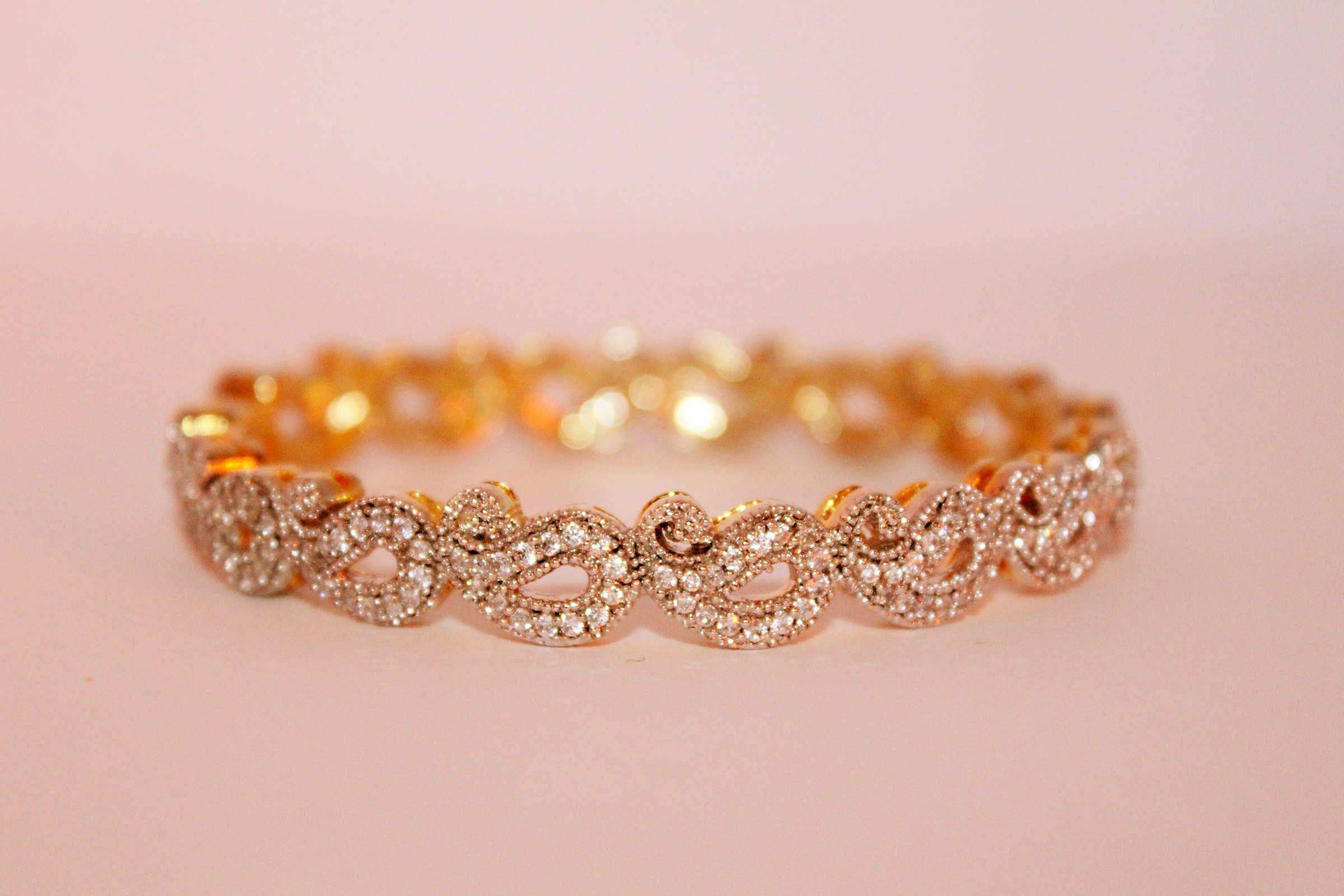
Marquise is a football-shaped brilliant cut — pointed at both ends. It has the largest face-up size per carat of any shape: a 1.0ct marquise looks larger on the finger than a 1.0ct round, oval, or pear.
Pricing 20-25% below round. Combined with the size bonus, marquise is the cheapest way to get a "big-looking" diamond.
Two sharp points are vulnerable to chipping. Settings must protect them — V-prongs at both tips, bezel, or half-bezel.
Marquise has fallen out of fashion since the 1980s peak. Resale market is thinner than other shapes, so factor in 30-40% resale (vs 35-50% for round) if resale matters.
At a glance
- Price vs round
- -22%
- Face-up coverage
- 1.25× (longer)
- Sparkle character
- Brilliant
- Resale liquidity
- Weak
- Length-to-width
- 1.75-2.25 (1.75-2.00 is the sweet spot)
- Clarity to buy
- VS2 / SI1
- Colour
- Check both ends before buying
- Setting
- V-prongs at both points, or a full bezel
- Watch out for
- Bowtie, and narrow stones are fragile
What the marquise is optimised for
The marquise is a brilliant cut stretched between two points, and its single job is face-up area. Because the outline runs long and narrow, the stone spreads more surface across the finger than any other shape at equal weight — the comparison table puts it at 1.25× a round, the highest figure on the page.
The shape is usually traced to an 18th-century commission for the Marquise de Pompadour, though that is trade tradition rather than a documented fact. What is measurable is the geometry: length, not carat weight, is what the eye reads, and a marquise puts its weight into length on purpose.
Proportions: ratio, bowtie, and fragility
A marquise lives or dies on three checks.
Length-to-width ratio
1.75-2.25 is the accepted range and 1.75-2.00 is where most marquises sit comfortably. Below 1.60 the stone looks stubby and loses the football read; above 2.25 it becomes a sliver, and the two points turn thin enough that the stone is fragile in daily wear.
Bowtie and light return
This is a long brilliant, so a bowtie is common. The test is the same one that applies to an oval or a pear: a band that moves and fades under tilted light is normal, a black bar that sits still is a cutting fault. Ask for video and look at the centre of the stone first — that is where marquises go wrong.
Symmetry of the two points
The points should sit exactly opposite each other; a marquise whose points are slightly off-axis sits crooked in a mount and reads crooked on the hand. The belly — the widest part — should be even on both sides. Both show up clearly in a straight-down photograph and on the plot in the report.
Clarity and colour for a marquise
The body hides inclusions well — brilliant faceting plus a busy pattern — so VS2 and SI1 are the value grades, exactly as in a round. The exceptions are the two ends: inclusions sitting in the points show up because there is less light scattering to mask them, and the points are the thinnest material in the stone.
Colour is the marquise weak spot. Tint collects in both ends, and that is where a grade you thought was safe will show first. Face the stone up in daylight, check each point against the body, and do it in white metal before buying if that is where it will live. H or better for platinum; I-J can work in yellow gold.
Settings, mistakes, and who it suits
Settings that protect both points
V-prongs at both ends, a full bezel, or a half-bezel wrapping each point. Anything else leaves a tip exposed, and a knocked point is the most common reason these stones come back damaged. If the ring is worn through gloves, tools or gym work, a bezel is the honest recommendation rather the pretty one.
Mistakes buyers make
Going as narrow as possible to maximise length — thin marquises are fragile and leak light. Fitting only one V-prong because the mount "holds it anyway". Buying without checking the bowtie. Ignoring colour at the ends. And underestimating resale before purchase, because this is the shape where that gap hurts most.
Who it suits
People who want the biggest possible look for the money, longer fingers where a 2:1 silhouette sits well, and anyone drawn to vintage or slightly unconventional rings. It is a poor fit for very hard-wearing hands unless it is bezel-set.
Price, resale, and what to expect
Marquise sits at the deep end: 20-25% under round in the pricing guidance, -22% on the comparison table, and 0.75× in the calculator model — tied with heart for the largest discount on this site. Add the 1.25× coverage figure and it is the cheapest route to a diamond that reads big.
Resale is rated Weak, and the site's own guidance puts marquise resale around 30-40% of retail against 35-50% for a round. The shape fell out of fashion after its 1980s peak, so the second-hand buyer pool is thin. Buy a marquise to wear, not to hold, and keep the GIA report if selling is ever a possibility.
Frequently asked questions
Does a marquise really look bigger than a round?
Face-up, yes: the comparison table puts a marquise at 1.25× the coverage of a round of equal weight, the highest of any shape. The trade-off is shape rather than size — you are buying length, so it covers the finger differently rather than just more.
Why do marquises need V-prongs?
The two points are the thinnest part of the stone and take every knock. A V-prong folds over the tip and absorbs the impact that would otherwise chip it. Both ends need one — a single V-prong leaves the second point exposed.
How do I know if the bowtie is acceptable?
Tilt the stone under a light. A band that shifts and fades as the angle changes is normal for an elongated brilliant. A dark bar that stays put across the centre is a cutting fault, and it will be visible in every lighting condition for the life of the ring.
Is a marquise a good investment?
As a stone to wear, yes — it is the most diamond per carat in the trade. As a financial asset, no. Resale is rated Weak here, the site's guidance puts it around 30-40% of retail, and the buyer pool is smaller than for rounds or ovals.